Tiszabogdány · Subcarpathia
I use the records meant to erase them to find family.
My grandmother, Helen, was the sole survivor of her immediate family in the Holocaust. For decades we had only stories. Then one prisoner card grew into more than 300 documents. This is how I reconnected with family lost for more than 80 years, and how you can look for yours.
This site uses her family as a case study. Everything here was found from home, online, by mail and through family, and every step can be repeated for another family.

 Photo found · 2026
after her death Helen’s Road · a mapped case study At 15, her letters home came back. No one was there. Hear it in her own voice ▶ Follow my grandmother’s roadFollow her road
Together again, 80+ years later. One surname. One shtetl. One trade.

2026Photo found
2026Photo found
2019
Tap or click a face for his record
Buchenwald intake, 2 June 1944: two brothers and their uncle, Helen’s father. All three were Helmans from Tiszabogdány, all three were wagon drivers, and they were photographed one after another. Their cards were then filed apart for more than eighty years. Here they are side by side again. In 2019 my mother found Zacharias’s card; in 2026 I found his nephews beside him. Arolsen Archives · prisoner cards 56906, 57103, 57101
Rare: most families find a prisoner card with no photograph, if they find one at all.
The map opens full screen. Press start to hear Helen’s voice, or watch without sound.
Helen, in brief
Helen Lando Helman was born in Tiszabogdány, a village in the Carpathians, in 1929. She was the sole survivor of her immediate family. In 1943 her mother took her to Budapest, and she lived through 1944 there, in the city’s dispersed ghetto of yellow-star houses and then hidden in a children’s safe house. Her mother, her father and her five brothers and sisters were murdered in 1944. Another little sister, Cecilie, had died in 1940, aged two. After the war she came to America, reaching New York in May 1947, aged 18. For decades there was nothing of them: no photograph, no grave, no dates.
In 2019 the Arolsen Archives put their records online, and my mother found one prisoner card: Helen’s father, Zacharias. The family assumed that was the end of it. The research began in 2026, and it has grown from there. None of it required travel. Follow her road on the map, or see the hints and mistakes it taught me.

What came back
From the archives, one record at a time.
1 card → 300+ documents
One prisoner card in 2019. Then hundreds more in 2026.


I find Holocaust families, and show you how to find yours.
One card in. A family out.
I work in process engineering, so this is how I see it. One record goes in. It passes through four steps. What comes out verified goes straight back in as the next search. What doesn’t hold up is set aside, and I keep a list of those too. That loop ran hundreds of times. Tap any box for real examples from Helen’s case.
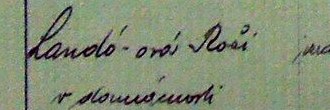
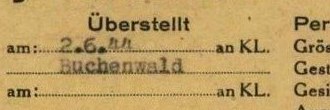
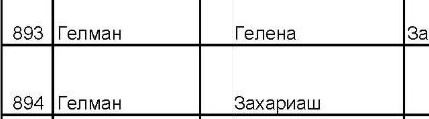
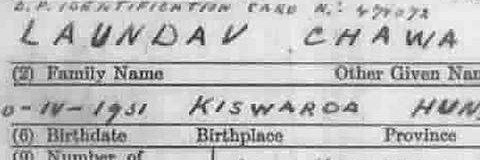
Each box links to its examples on the method page. A set-aside lead can come back, or be crossed off once the sources show it’s someone else. “Set aside” links to my mistakes.
Read the methodThe four steps in detail, my hints, the walls I hit, my mistakes, and every database I used.Open the method →Why I do this
I do this research from Hawai‘i, about as far from Europe as you can get.
I speak only English, so AI helps me read the records, and I check every one against the page. I was never trained in this; I work in process engineering, and engineers take a finished thing apart to see how it was made. I do the same with a family.
Both of my grandparents on my mother’s side survived the Holocaust: Helen Lando Helman and Tibi Katz. Helen helped raise me. I was the youngest, and when she stayed with us, she shared my room.

The records made to erase them can find them.
The story does not end with them. Now it is our turn, the second and third generations, to carry it on.
Start with one name and one town. Write every form of the name. Then follow the four steps.
The guide is free, and so are most of the databases. I’m one person, and I can’t research every family, but I help where I can, and I hope you’ll try it yourself.
